I rather like Jeff Koons. Some may (actually many do) consider his works kitsch, but I think his use of stainless steel in his Celebration series to sculpt balloon animals, egg shells, and ribbons is the most interesting use of material I have seen. There are many more things to say about Koons' art like how strange it is look at his innocent balloon animals after having seen his Made in Heaven series.
But, in more recent event, Koons has partnered with Kiehl's to create limited edition of Kiehl's Creme de Corps line of products.
These limited edition items feature, on the label, a reproduction of Koon's Tulips from his Celebration series which is an oil painting made to look like his stainless steel Tulips.
The good of all this? Proceeds from the sale will benefit the Jeff Koons Family Institute, a non-profit organization. Here's an excerpt with more information from the website:
I actually use something from the Creme de Corps collection. It's pretty good. So if you are running low and want to try a new lotion, consider Kiehl's! You will be helping some children out!
What a great week for some of my favorite artists. My last post was dedicated to Sofia Coppola, the winner of this year's Venice Film Festival's top prize--the Golden Lion--for her newest film Somewhere.
Last night, Lady Gaga won multiple MTV's Video Music Awards(almost every category she was nominated for) for her videos Bad Romance and Telephone. Yay for Eminem's wins as well. Before his latest album, Recovery, I did not like him for the most part. But I feel like he has emerged this year with more maturity and humanity (at least with the two singles released so far).
And lastly, The xx won UK's Mercury Prize beating 11 other nominees.
P.S. Lady Gaga's meaty dress has been done before. In 2002, contemporary Chinese artist, Zhang Huan, wore a meat suit in his performance art piece My New York. The idea was quite similar--post 9/11, Huan walked through the streets of NYC in a muscle/meat suit to symbolize the strength of New Yorkers.
The Art of the Steal, a documentary on the government and private interest groups' hostile efforts to make a private art collection into a public collection, has been making me think about the issues presented.
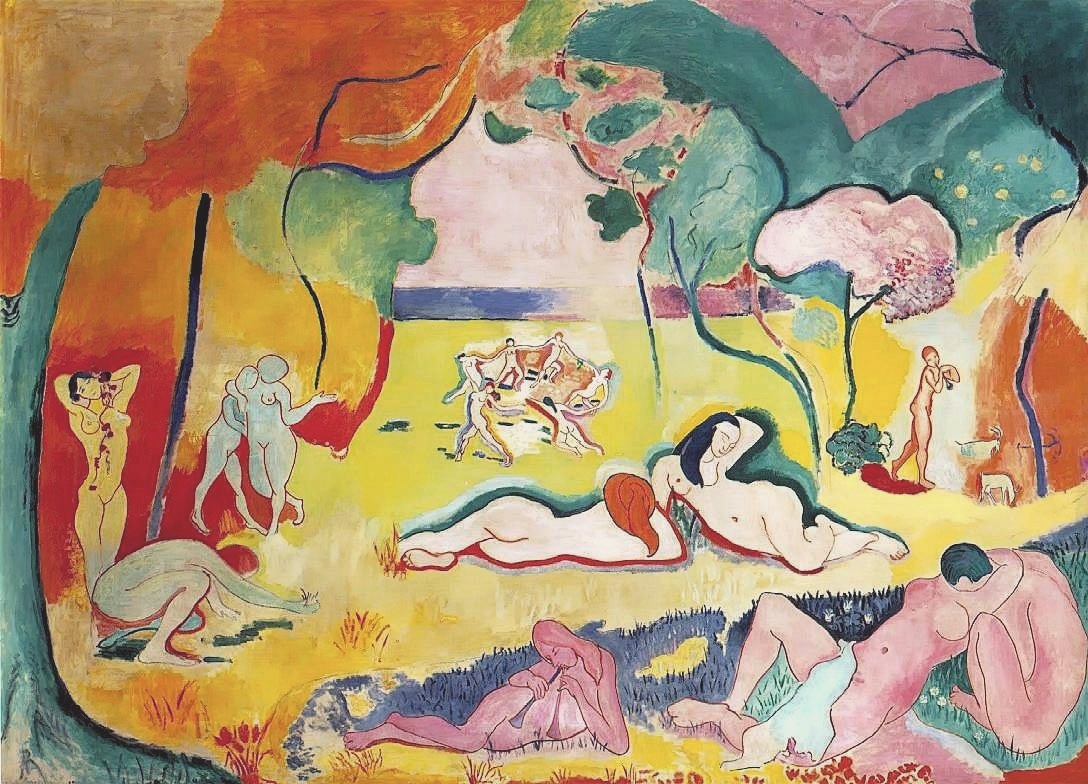
The documentary follows the fate of the art collection of Albert Barnes who made a mass fortune inventing the antiseptic drug Argyrol. Appropriately, Barnes' art collection was put in the trust of the Barnes Foundation located outside of Philadelphia. The Foundation is not only a house of art but also an educational institution. Barnes' collection includes 181 Renoirs, 69 Cezannes, 60 Matisses, 44 Picassos, and 14 Modiglianis. He has Matisse's The Joy of Life, a masterpiece that was extensively discussed in my art history course, Van Gogh's Portrait of the Postman Joseph Roulin, and Seurat's Models. All in all, Barnes collected around 9,000 pieces of art valued at over $25 billion today. His Impressionism-focused collection, according to the documentary, is larger than that of the Met or the MoMA.
Despite having such a great collection, Barnes did not welcome the public to see it for one important reason. In 1923, Barnes put on an exhibition of his collection but was completely dismissed by the critics. At the time, his Pre-/Post-/Impressionist and Fauvist collection was considered too avant-garde, unrefined, primitive by the elite and art critics of Philadelphia. After this incident, Barnes grew extremely antagonistic towards those who did not appreciate his art collection-namely, the elite and art critics. Barnes then closed the door to his collection to those people but welcomed students, art educators, and the working people. Along the way, Barnes made many enemies.
To prepare for, what he foresaw as, the fate of his art collection, Barnes wrote in his will that the collection will never leave the Barnes Foundation, be lent, toured and basically fall in the hands of those who had despised. Additionally, the collection would only be opened to the public two days a week according to his will. Sadly, Barnes' will was not honored. A few decades after Barnes' death, the physical building of the Barnes Foundation fell into disrepair, funding ran low, and control of the collection entered the hands of people who had other plans for the famous/infamous art collection.
The collection was sent on an extremely successful world tour. The Foundation opened up to the public completely. And without a champion for Barnes's vision and will, long-time enemies of Barnes crept up to some control of the Foundation. Today, a new building is being constructed just adjacent to the Philadelphia Museum of Fine Arts to house the new Barnes Foundation--the ultimate insult to Barnes who hated the Philadelphia MFA for every thing it stood for.
So the issues at hand: Should the Barnes Foundation be opened to the public? Should the paintings be toured? lent? Should Barnes' will be honored despite the caliber of the collection?
I am having a hard time answering most of these questions. Originally, I thought it is important to honor Barnes' will and that the collection should not leave the original setting of where the collection is intended to be housed and viewed . Barnes arranged his collection in a way that is different from museums. Paintings are not grouped by artistic styles, periods, or by artists; instead, Barnes' paintings are group among furnitures and decorative art to create aesthetic synergy. In some ways, it's like the Frick Collection where you are experiencing someone's house--the way where each artwork is hung and where each furniture is placed give insight into Frick's life and taste. On the other hand, this argument is also an unanswered questions by the age old dilemma of the Parthenon Marbles. Does the original setting of the artworks illuminate the works, provide greater meaning, and provoke greater appreciation?
But if Barnes' will is followed through, this also means the masterpieces within the collection will not be opened to the public as much as I think it should be. I can probably go on and on about the topic and never really reach a conclusion. After all, 200 years later, the debate on the Parthenon Marbles still continues.
Art authentication is possibly one of the most interesting topic to me. One of the only few books I have finished from start to end is The Forger's Spell: A True Story of Vermeer, Nazi, and the Greatest Art Hoax of the Twentieth Century by Edward Dolnick. The book is about an art forger using chemistry, psychology, and historical circumstances to fool all of Europe. The most thought provoking notion that the book raises is that the best forgeries are those that are still hanging in museums disguised as old masters.
A compelling and fascinating article on NY Times on the ownership of antiquities specifically on the ownership of the Parthenon marbles. I've heard this topic discussed a couple times during my art history courses. Michael Kimmelman, the author, does a great job discussing the evolution of how antiquities become prized: if Lord Elgin did not take the Parthenon marbles, the Greeks would not have valued it so much.
Xu Bing (徐冰) is one contemporary Chinese artist that I am writing my paper on for my Contemporary Chinese Art course. Born in 1955, he lived through the Cultural Revolution. He created A Book from the Sky to express his mistrust and skepticism of language and words that developed during the Cultural Revolution. During the Cultural Revolution and under Totalitarianism, governments often manipulate and distort words and language to express their ideas and get people to believe in their ideology. Conceived over a number of years, Xu Bing fabricated words that resembles Chinese characters but have no meaning. He carved every single character by hand and printed this installation artwork. The result is a hauntingly beautiful, traditional yet avant-garde work of art.
If we have ever talked about the type of art I like, I have probably said Asian art is inferior to Western art. Asian art, to me, is inferior because Asian artists lack individuality. Chinese paintings (you know those ink, scroll paintings) all look the same; they all seem to be painted by the same person or produced from a factory. In a way, Chinese paintings are like the manuscripts of the Middle Ages. The only Asian artist that I can name off the top of my head is probably Hiroshige who I know from studying Western art.
Last week, however, I was pleasantly surprised when I visited the Taipei Fine Arts Museum. They are currently exhibiting the work of Cai Guo-Qiang who I had never heard, but should have, before last week. Cai Guo-Qiang has exhibited at the Solomon Guggenheim, Tate Modern, Sackler Gallery, the Met, and won at the Venice Biennale. His large-scale installation works are unusual, provocative, and expressively beautiful. I got the same feeling at Cai's exhibition as when I visited the Saatchi Gallery.
Romaine Brooks, Self-portrait, 1923, Oil on canvas, Renwick Gallery (Smithsonian)
Romaine Brooks' paintings are dark, intense, exceedingly haunting, yet mesmerizing. As a child, Brooks was neglected by her abusive mother who spend all her time caring for Brooks' older, mentally ill brother. Her childhood is strongly reflected within her depressing paintings of cold, dark, and heavy colors.
At last, the Anish Kapoor exhibit opened at the Royal Academy of Art. I have been anticipating for the exhibit since the semester began. Anish Kapoor is a Indian-British sculptor whose art is often quite minimalist, colorful, and monumental. He designed the famous Cloud Gate in Chicago.
His latest exhibit at the Royal Academy is a sensory wonder. He created several mirrored objects that distort your image and even your vision. They're almost like carnival mirrors but beyond. What I meant by distorting your vision like how your head feels when you stare at a black and white checker pattern for too long. I had the most difficult time figuring out what exactly is happening. After staring at them for too long, I got a bit sick.
Another piece of art is called Yellow. It's a gigantic yellow wall that is concave. At the first glance, it was hard to tell if the wall is concave or convex. And after a while, it's still very difficult to tell exactly how deep the wall curves in.
The centerpiece of this exhibit is titled Svayambh. It is a 30 ton block of red wax that moves at a snail's pace through five galleries. When passing through each gallery, the wax pushes itself through the arched doorways. The process leaves behind residues on the walls, the arches, and the ground. (It's incredible that the Royal Academy allowed Anish Kapoor to do this. The building is a beautiful, I'm guessing, late 18th structure with marble arched doorways and ornate, carved ceilings. Clean up will be a huge tastk!) But also through this process, the wax block is creating a form for itself. The idea of this piece is well reflected by its title--Svayambh means "self-generated" in Sanskrit. Anish Kapoor wanted to create an artwork that breaks away from the traditional method of making sculpture which is through the hands of a sculptor.
Unfortunately, I was not allowed to take photos inside. It is often the case that photography is not allowed in temporary exhibits, and especially in the UK, not allowed in "galleries." In the UK there is a clear distinction between "galleries" and "museums." Galleries hold paintings while museums hold objects. I think this is a brilliant way of distinguishing between the two type of museums.
What I was allowed to take photos of is this fantastic sculpture in the Royal Academy's courtyard. Anish Kapoor works are innovative in the use of unexpected materials, explosively vivid in the use of colors, and minimalist in the use of simple shapes and clean lines. Once again, I am obsessed!!!
I ran into this wonderful table at Selfridges. Completely unexpected, didn't know such a book was getting published, but what a wonderful surprise! So I bought it. The book is like an interview with Charles Saatchi the co-founder of Saatchi & Saatchi and founder of the Saatchi Gallery.
My favorite answer so far is this:
Page 100 Question: I know very little about contemporary art but have £1000 to invest. Any advice? Answer: Premium bonds. Art is no investment unless you get very, very lucky, and can beat the professionals at their game. Just buy something you really like that will give you a thousand pounds' worth of pleasure over the years. And take your time looking for something really special, because looking is half the fun.
Limbour as a Crustacean, 1946, Oil and sand on canvas, Hirshhorn
Actor in a Ruff, 1961, Oil on canvas, Hirshhorn
I first saw Dubuffet's works during the summer in Washington, D.C. at the Hirshhorn Museum and Sculpture Garden. I immediately found his works intriguing. There's something so childish, cartoonish about Dubuffet's artwork. Yet, there is something strange, nightmarish about the way he portrays his subjects. The crustacean man looks so disturbing. And the actor looks somewhat guiltless, yet with all the roughness, darkness of the background he looks a bit sinister.
I am obsessed with everything Saatchi: Saatchi & Saatchi, Saatchi Gallery, Charles Saatchi, Maurice Saatchi and whatever Saatchi that's left out there. You'll know why once you try pronouncing the word--Saatchi.
Saatchi Gallery is famous and infamous for exhibiting the artworks of the Young British Artists; most famous of the YBAs is Damien Hirst while I really like Sam Taylor-Wood (partly because of her name). The space at the Saatch Gallery is open, clean, and bright. There is a lot of space for a relatively small number of works. I thought the emptiness made you focused on the works more. It allowed you to contemplate about the artworks--a lot of which are ambiguous, conceptual, and unusual. After all, the Saatchi Gallery is a contemporary art gallery. But you really wouldn't except this from the outside as the gallery is in a stately estate.
One of my favorite pieces is the wooden square. It's one piece in a series of three. It's like nothing yet everything. There's so much emptiness about it. It's simple, minimalist, clean and it reminds me of a piece of Ikea furniture. I also like the grey rectangles a lot. I spent a good deal of time in front of this piece. Each of the vertical sections used to be one block. The artist then cut them into thinner slices so you see how they change.
The most disturbing work is the men in the wheelchairs. They move! Those wheelchairs around the space that they are in. They bump into each other, into the walls, and they come right at you. The men are made to look somewhat like world leaders. It's sad.
Vermeer, Officer and Laughing Girl, 1657, Oil on canvas, Frick
This is my favorite Vermeer that I have seen in person. During a special exhibit at the Frick Collection in New York City, this painting along with the two other Vermeers in the Frick Collection were hung side by side. The light in Officer and Laughing Girl glows beautifully, is still, and warm. The light has a quality that will capture your attention.
Eugene Delacroix, The Barque of Dante (Dante and Virgil in Hell), 1822, Oil on canvas, Louvre
The Barque of Dante was Delacroix's entry to the 1822 Salon. It won him considerable fame and Delacroix became a leading figure in the Romantic movement. Delacroix played with color theory painting water drops with red, yellow, green, and white to create what looks like the color of water. This painting is also much influenced by Gericault's masterpiece, The Raft of the Medusa.
Update: Karsh photo titled Man Ray is today's (8/27/09) featured work of art from the Met's permanent collection! :D The Met's Website
During my internship program this summer, we visited the Canadian Embassy which is having an exhibit named Karsh at 100: Portraits of Artists. It celebrates Yousuf Karsh's 100th birthday with a small collection of portraits of famous artists. Of the 28 portraits in exhibit, my favorite is the one of Georgia O'Keeffe.
The clean and defined lines of O'Keeffe's figure make her appear strong and dignified despite her looking aged and thin. Her hands stand out and look quite large and the juxtaposing skull, I am guessing, are showcased in allusion to her legacy as an artist. This portrait is powerful.


 And lastly, The xx won UK's Mercury Prize beating 11 other nominees.



 Bronzino, An Allegory with Venus and Cupid, 1545, Oil on canvas, National Gallery, London


 Limbour as a Crustacean, 1946, Oil and sand on canvas, Hirshhorn
 Actor in a Ruff, 1961, Oil on canvas, Hirshhorn


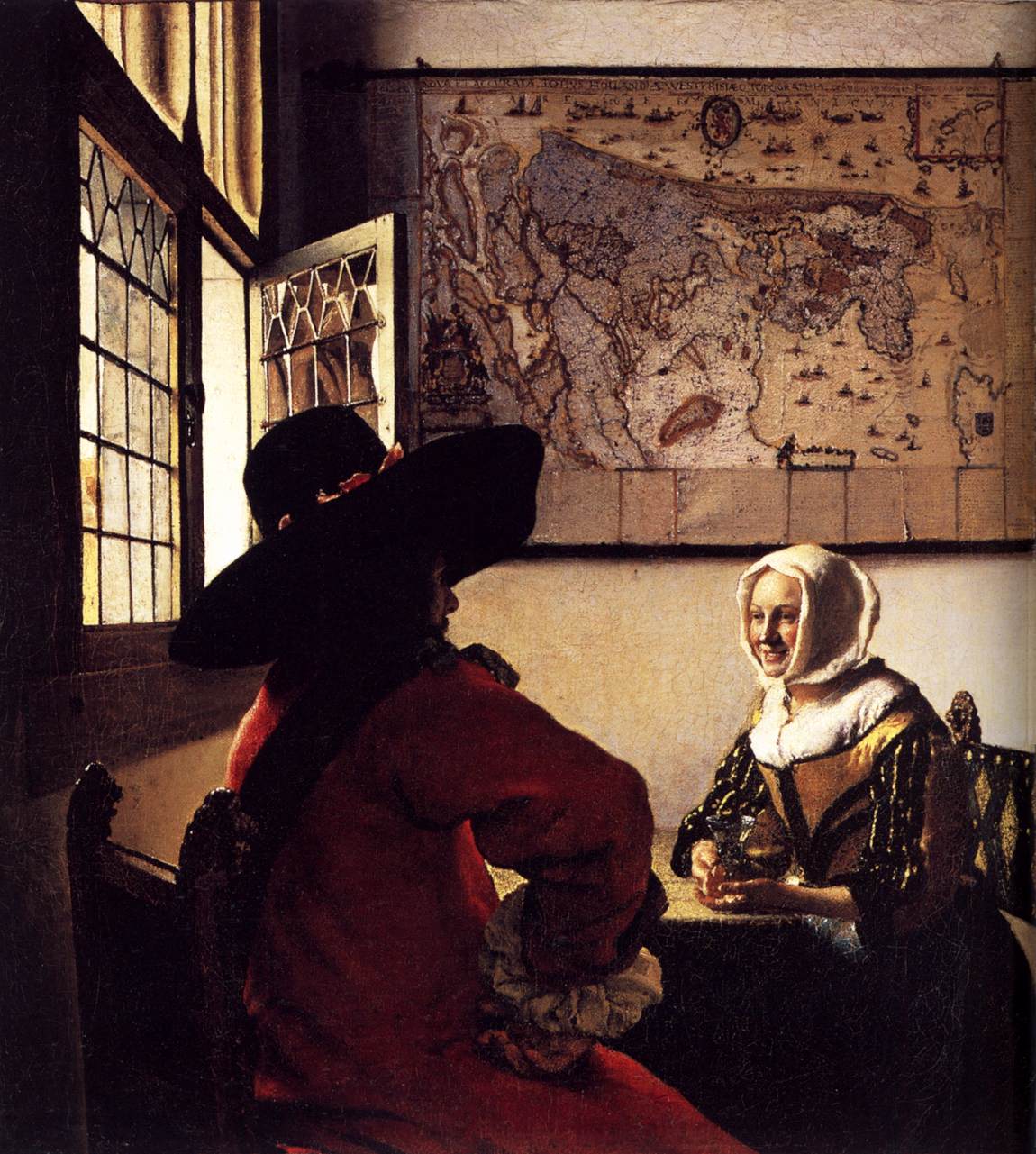 Vermeer, Officer and Laughing Girl, 1657, Oil on canvas, Frick
 Eugene Delacroix, The Barque of Dante (Dante and Virgil in Hell), 1822, Oil on canvas, Louvre